Lipedema is a real, physical, chronic condition. It is not a weight problem, and it is not your fault.

Full-width editorial photograph: a woman, mid-shot, natural light, unposed. Warm, human, dignified.

Lipedema is a disorder of the body's fat tissue that almost only affects women. It causes a symmetrical build-up of painful, tender fat on the legs, hips, and sometimes the arms, and it does not shift with diet or exercise the way ordinary weight does. Doctors at the Mayo Clinic first described it in 1940. Most women still wait decades for a diagnosis.

Lipedema is a disorder of the fat that sits just under the skin. In women who have it, that fat behaves differently: it becomes inflamed, it holds on to fluid, it hurts to touch, and it builds up in a pattern that stops sharply at the ankles and wrists.

It is almost always symmetrical. It almost always spares the hands and feet. It is almost always painful in a way ordinary fat is not. And it almost always resists calorie restriction, even when the rest of the body loses weight.

It is not obesity. It is not lymphoedema. It is its own condition, with its own biology, and it has been in the medical literature for more than eighty years.
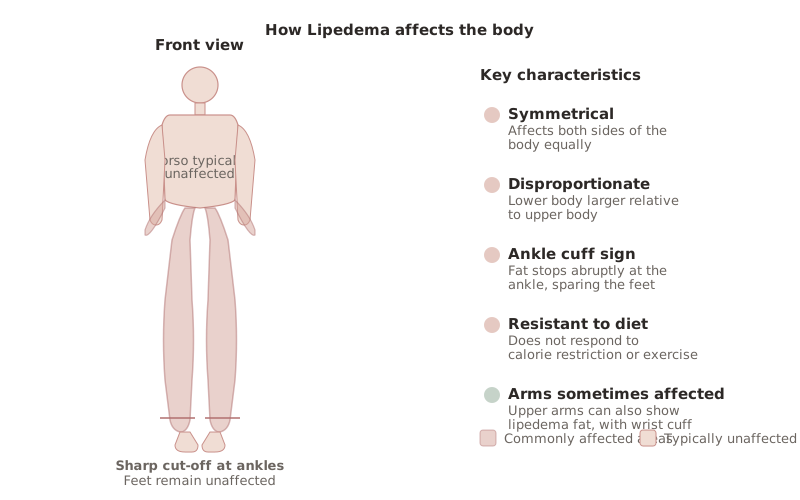
At a glance

Simple line-art diagram: symmetrical legs showing Lipedema fat distribution, sharp cut-off at ankles. Arms optionally affected. Warm accent colour.

Both legs, both arms, never one side only.

The classic "cuff" or "bracelet" at the ankle is one of the clearest physical signs.

Tender, bruises easily, and often aches at the end of the day.

The affected fat does not shrink the way normal fat does, even with significant weight loss.

Around 6–11% of women are thought to have it. It is very rarely seen in men.

Symptoms often appear or worsen at puberty, pregnancy, or menopause.

What the research says

Strong

Evidence rating: Strong for the existence and core features of Lipedema. Allen and Hines described it at the Mayo Clinic in 1940. The 2021 US Standard of Care and the 2024 German S2k guideline confirm the distinctive pattern, the pain, the hormonal link, and the resistance to dieting. The World Health Organization recognises it as a distinct disease in ICD-11.

Evidence rating: Emerging for exactly why the tissue behaves this way. Researchers are still working it out, with recent studies pointing to a mix of hormonal signalling, inflammation, fibrosis, and genetic predisposition.

What this means for you

If this sounds like what you are living with, you are not imagining it, and you are not alone. Lipedema is under-diagnosed, not rare. The first step is knowing what it is. The second is finding a doctor who also knows what it is, and that part, sadly, still takes time.

Where to go next

  1. [1] Allen EV, Hines EA. Lipedema of the legs: a syndrome characterized by fat legs and orthostatic edema. Proceedings of the Staff Meetings of the Mayo Clinic, 1940; 15: 184–187. View source →
  2. [2] Herbst KL, Kahn LA, Iker E, et al. Standard of care for lipedema in the United States. Phlebology, 2021; 36(10): 779–796. View source →
  3. [3] Faerber G, Cornely M, Daubert C, et al. S2k guideline lipedema. JDDG: Journal der Deutschen Dermatologischen Gesellschaft, 2024; 22(9). View source →
  4. [4] Kruppa P, Georgiou I, Biermann N, et al. Lipedema — Pathogenesis, Diagnosis, and Treatment Options. Deutsches Ärzteblatt International, 2020. View source →
  5. [6] Aday AW, Donahue PMC, Garza M, et al. National survey of patient symptoms and therapies among 707 women with a lipedema phenotype in the United States. Vascular Medicine, 2024. View source →
  6. [7] Lipedema: Clinical Features, Diagnosis, and Management. Review, 2024. View source →
  7. [8] Lipoedema UK patient survey, 2021. View source →
  8. [11] Szél E, Kemény L, Groma G, Szolnoky G. Lipedema and the Potential Role of Estrogen in Excessive Adipose Tissue Accumulation. International Journal of Molecular Sciences, 2021. View source →
  9. [12] Menopause as a Critical Turning Point in Lipedema: The Estrogen Receptor Imbalance, Intracrine Estrogen, and Adipose Tissue Dysfunction Model. PMC, 2025. View source →
  10. [14] Lipedema and adipose tissue: current understanding, controversies, and future directions. Frontiers in Cell and Developmental Biology, 2025. View source →
  11. [15] Impact of hormones on lipedema development: a systematic literature review. PMC, 2024. View source →
  12. [16] Morgan J, Michelakis D, Keeley V, et al. A Family-Based Study of Inherited Genetic Risk in Lipedema. Lymphatic Research and Biology, 2024. View source →
  13. [18] Lipoedema is not lymphoedema: A review of current literature. PMC, 2021. View source →

Last reviewed: 5 April 2026. Lipedema research is evolving, and where evidence is still emerging, we say so. This page is for information only and is not a substitute for medical advice. Read the full disclaimer.