Understand
Lipedema is not caused by what you eat or how you live. The biology that drives it runs much deeper than that.

Understand
Lipedema is not caused by what you eat or how you live. The biology that drives it runs much deeper than that.
Lipedema has a strong genetic component, with a clear familial pattern. It is thought to involve hormonal signalling, abnormal fat cell behaviour, inflammation, and dysfunction in the small blood and lymphatic vessels. It is not caused by diet, lifestyle, or excess calorie intake, even though it is frequently confused with obesity.
Lipedema is not a consequence of lifestyle choices. This is one of the most important things to understand about the condition, because the opposite assumption causes real harm. Women with Lipedema are routinely told to eat less and move more, as though those things could reverse what is happening in their tissue. They cannot, and the research is clear on why.
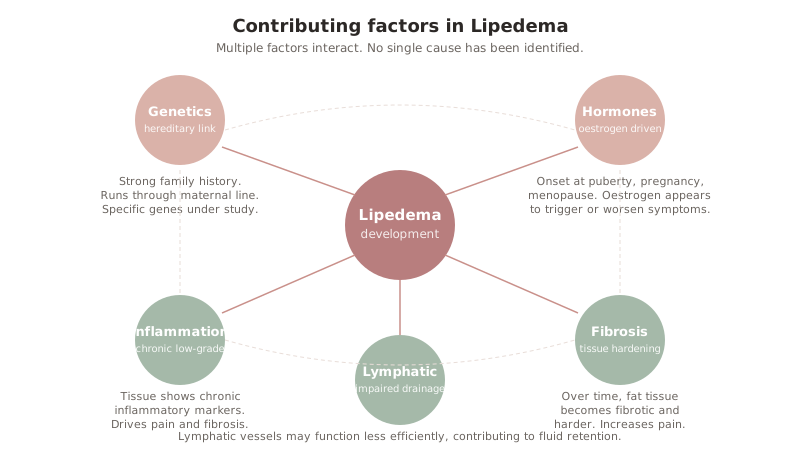
The strongest evidence for the cause of Lipedema points to a genetic predisposition combined with hormonal signalling. The familial pattern is one of the most consistent clinical observations in the field. Mother-daughter transmission is particularly common. A 2024 study by Morgan and colleagues identified inherited genetic risk in families with Lipedema, and a 2022 multi-gene panel study found multiple candidate genes associated with the condition. No single causal gene has yet been confirmed, which is why the evidence is rated Emerging rather than Strong, but the direction of research is clear.
Oestrogen appears to be a key driver of how that genetic predisposition expresses itself. Lipedema almost exclusively affects women and characteristically emerges or worsens at points of hormonal change: puberty, pregnancy, and the perimenopause. Research published in 2024 found that oestrogen treatment significantly increased adipogenic markers in Lipedema fat cells, suggesting that the hormone actively promotes the abnormal behaviour of the tissue. The affected fat cells are larger and more numerous than ordinary fat cells, and they appear to be surrounded by a different kind of connective tissue matrix.
Inflammation and fibrosis are also part of the picture. The tissue in affected areas shows signs of chronic low-grade inflammation, and over time the fat becomes increasingly fibrotic, meaning it is interspersed with dense, scar-like connective tissue. This is part of why Lipedema tissue feels different to touch, and why it is painful in a way that ordinary fat is not. The small blood vessels and lymphatic capillaries running through the tissue are more fragile and leaky than normal, which contributes to swelling and may worsen as the condition progresses.
The 2025 reviews in Frontiers in Cell and Developmental Biology and npj Metabolic Health and Disease both describe Lipedema as a condition involving the intersection of genetics, hormonal regulation, immune activity, and structural changes in the fat tissue. It is not one simple mechanism. But none of those mechanisms are under your conscious control, and none of them are your fault.
Evidence rating: Emerging for the underlying causes of Lipedema. The familial pattern is well-established in clinical observation and supported by a 2024 genetic study that identified inherited risk factors in families. A 2022 multi-gene panel study found multiple candidate genes. However, no single gene has been confirmed as causal, and the interaction between genetics, hormonal signalling, and tissue behaviour is still being mapped. Research into inflammation, fibrosis, and lymphatic dysfunction as contributing factors is active and growing. The 2025 Frontiers in Cell and Developmental Biology review and the 2025 npj Metabolic Health and Disease paper reflect the current state: a complex, multi-factor picture that is becoming clearer but is not yet fully understood.
Understanding that Lipedema has a genetic and biological basis is important for two reasons. First, it means you did not cause this. No diet you failed to stick to, no exercise routine you did not maintain, is responsible for what is happening in your body. Second, it means your daughters and sisters may be at higher risk. If you have close female relatives with similar symptoms, they are worth telling about Lipedema. An early diagnosis, before significant progression, opens up more management options.